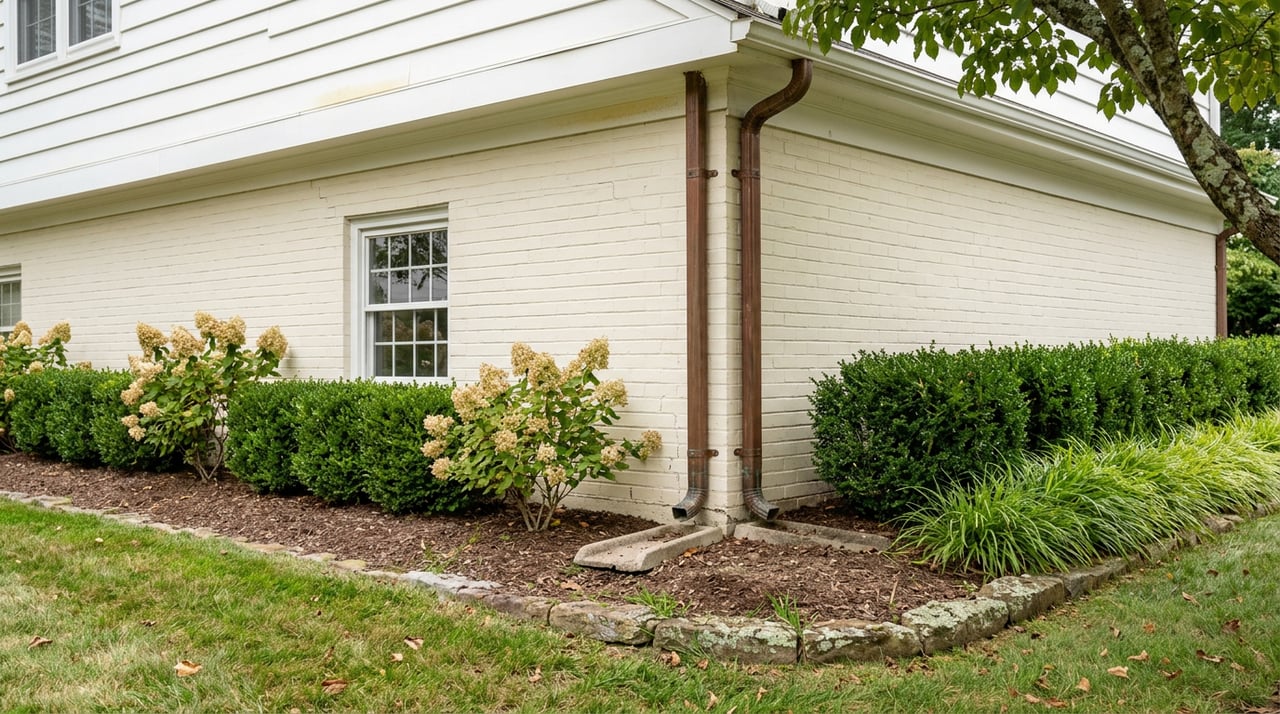
The call usually comes on inspection day. The home inspector's voice is calm, almost routine, because for anyone who has worked in Summit's older housing stock, this is not a rare find: "There's a fill pipe in the side yard. No tank we can see. Someone converted this place to gas a long time ago."
For a seller who has already signed a contract, negotiated a price, and started packing, that sentence lands differently than it should. It sounds like a repair item. It is actually a scheduling problem, and the two are not the same thing.
Two very different processes hide inside one phrase
Most guidance on underground oil tanks in New Jersey treats "tank removal" as a single event: dig it up, haul it away, move on. In practice, once a contractor's shovel hits metal, the process splits into two branches that behave nothing alike, and which branch you land on is not something you control.
If the tank comes up clean, meaning no holes, no discolored soil, no odor, the local building department inspects it on site and closes the permit with a Certificate of Approval. That paperwork typically takes a few weeks to process, depending on the township.
If the tank shows signs of a discharge, the process leaves the municipal building department entirely and becomes an environmental matter. A licensed subsurface evaluator or Licensed Site Remediation Professional has to investigate, document the extent of the contamination, and file a Remedial Action Report with the New Jersey Department of Environmental Protection along with a $400 review fee. Only after that review is complete does the state issue a No Further Action letter, the document that actually satisfies a buyer's attorney and their lender.
| Clean tank, no leak | Leak or contamination found | |
|---|---|---|
| Who inspects | Local building or health department | Licensed environmental professional |
| Governing body | Municipal permit process | NJDEP Site Remediation Program |
| Closing document | Certificate of Approval | No Further Action (NFA) letter |
| Typical cost | Removal only | Removal plus remediation |
| Typical timeline | A few weeks | Weeks to several months |
That second column is the one that catches sellers off guard, because a standard New Jersey attorney review period and inspection contingency simply were not built with a months-long environmental filing in mind.
Why this comes up so often in Summit specifically
This is not a hypothetical for Summit sellers the way it might be in a newer subdivision. Housing age data for the city puts the median construction year at 1953, with roughly a third of homes built before 1940. That places a large share of Summit's housing stock squarely in the decades when oil heat was the regional default and buried steel tanks were standard equipment, long before most of these homes ever saw a natural gas line.
A tank that has been in the ground since the Truman or Eisenhower administration is well past the twenty-to-twenty-five-year service life environmental contractors generally cite for underground steel tanks before rust becomes a real concern. Many of these tanks were never formally closed. They were simply abandoned in place when a homeowner switched to gas, with the fill pipe capped or buried and the paperwork lost somewhere along the way.
The City of Summit's own building code even has a line item for this exact scenario: a $50 municipal permit fee for the removal of a storage tank, tucked into the fee schedule under Chapter 14 of the city's building and housing ordinance. It is a small number, but it tells you the city built a specific, recurring process for this specific, recurring situation.
What it actually costs, in both directions
New Jersey contractors publishing current pricing generally quote $1,500 to $3,500 for a standard underground tank removal with no contamination found, covering permits, excavation, soil sampling, disposal, and backfill. Above-ground tank removal runs less, typically $1,500 to $2,500, since there is no excavation involved.
Once contamination enters the picture, the number stops being a flat fee and becomes a range tied to severity. Minor contamination confined to the immediate pit area tends to add $2,000 to $5,000 to the base removal cost. Contamination that has spread beyond that pit, requiring extended excavation and groundwater testing, typically runs $10,000 to $30,000. A full-scale plume that has migrated off the property, requiring a Licensed Site Remediation Professional and Site Remediation Program oversight, can reach $50,000 to $100,000 or more.
Homeowners insurance is not a reliable backstop here. Environmental contamination from a heating oil tank is explicitly excluded from most standard homeowners policies, and while some New Jersey carriers offer an oil tank endorsement, coverage is the exception rather than the rule.
Disclosure is not optional, and "as is" does not erase it
New Jersey requires sellers to disclose known material conditions on the Seller's Property Condition Disclosure Statement, and an underground storage tank, whether active, inactive, or believed to be removed, falls squarely into that category. Selling a property "as is" shifts inspection responsibility to the buyer, but it does not eliminate the seller's underlying disclosure obligation, particularly for something a typical walkthrough would not reveal on its own.
Here is the detail that surprises a lot of sellers who converted their home to gas heat decades ago and assumed the old tank was someone else's problem: if there is physical evidence of a tank, an old fill pipe, a capped vent, copper lines running to a spot in the basement wall, that evidence counts as something you knew or should have known. Claiming ignorance after the fact does not hold up well if a home inspector finds what a seller's own basement has been showing for years.
The lending trapdoor that shows up late
Even a motivated buyer who is comfortable with the risk often cannot get the loan to close around it. Most conventional lenders will not approve a mortgage on a property with a known buried tank lacking closure documentation, and FHA and VA loans will not close at all on a property with an unresolved underground tank. That reality has nothing to do with negotiation and everything to do with underwriting, which means it surfaces at the worst possible moment: after a rate lock, after a moving truck is booked, sometimes after a buyer's old lease has already ended.
The fix is timing, not effort
Every piece of this process, the sweep, the removal, the permit, the environmental filing if one becomes necessary, is something a seller can start before a home ever hits the market. What breaks deals is not the tank. It is discovering the tank during a fourteen-day attorney review window and hoping the paperwork resolves faster than it usually does.
For a seller preparing an older Summit home, this belongs on the same pre-listing checklist as staging and contractor coordination, not on the list of things to worry about after an accepted offer:
- Order a tank sweep before listing, not during attorney review
- Pull together any old receipts, service records, or conversion paperwork from the switch to gas, if any exist
- Ask the municipality directly whether tank permits route through the building department or the health department, since it varies by town
- If a tank turns up, budget mentally for both branches of the process until you know which one you are in
- Loop your listing agent in early so the timeline gets built into the marketing calendar rather than discovered mid-contract
This is the kind of groundwork that separates a clean, on-schedule closing from a deal that stalls in attorney review for reasons that have nothing to do with price or negotiation.
A few questions we hear often
If I converted to gas years ago, is the old tank definitely gone? Not necessarily. Many homes that switched to gas heat still have the original underground tank sitting in the yard, simply disconnected rather than removed. If the vent and fill pipes were taken out at the time of conversion, a visual walkthrough will not tell you one way or the other, which is exactly why a sweep exists.
If the sweep comes back clean, am I in the clear? A clean sweep means no anomaly was detected during that scan, using the equipment and areas covered at the time. It is strong evidence, not an absolute guarantee, which is why documenting the sweep in writing matters for the closing file even when the news is good.
Can I just sell as is and let the buyer sort it out? You can market a home as is, but that does not remove the requirement to disclose a known or suspected tank on the state disclosure form. It also does not change what a buyer's lender will require before funding the loan, so an as-is listing with an undisclosed or unresolved tank tends to create more friction at closing, not less.
Older homes carry character that newer construction cannot replicate, and in Summit that character is part of what buyers are paying for. Getting ahead of a question like this one is simply part of presenting that home well. If you are weighing a sale and want a clear-eyed look at what your specific property might involve, Judith Daniels offers a complimentary market consultation to walk through exactly that, before a single sign goes in the yard.